
🇨🇦 Canadian-Owned and Operated!
If you are looking into testing for sleep apnea, you may see two terms used often: home sleep test and sleep study.
They are related, but they are not the same.
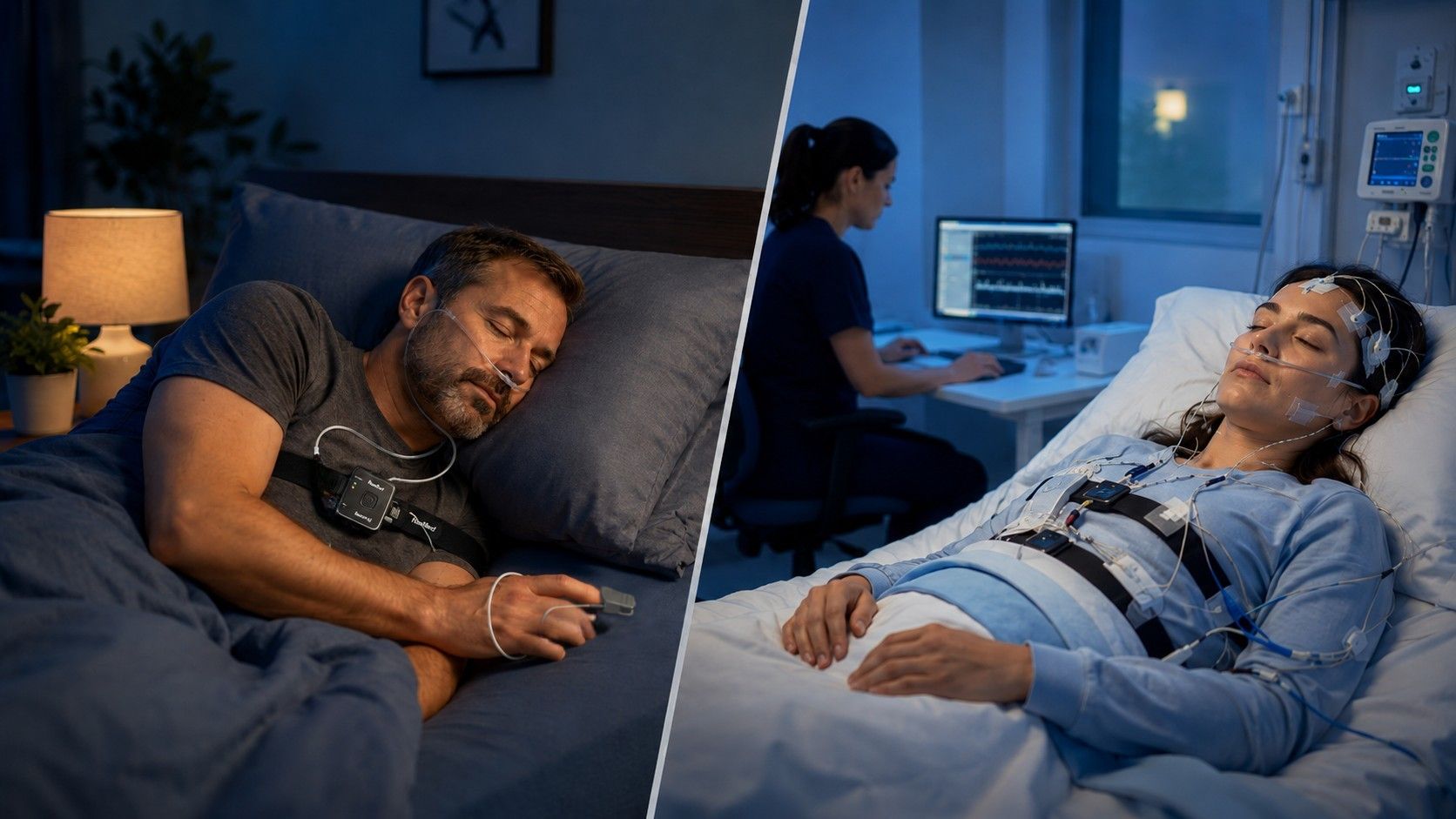
A home sleep apnea test is usually done at home and focuses mainly on breathing-related signals linked to obstructive sleep apnea. A sleep study, also called polysomnography, is usually done in a clinic or hospital and measures a wider range of sleep-related functions.
A home sleep test is a more targeted at-home test often used when obstructive sleep apnea is suspected. A sleep study is a more detailed overnight test used when a broader sleep evaluation may be needed.
Waking up gasping can happen for several reasons, including congestion, asthma, reflux, or sleep apnea. But when it happens repeatedly—especially alongside snoring, poor sleep, or daytime fatigue—a sleep-related breathing issue may be worth ruling out.
Where it happens
At home
In a clinic, sleep centre, or hospital
Main purpose
Assess suspected obstructive sleep apnea
Evaluate sleep in more detail
What it measure
Breathing-related signals such as airflow, breathing effort, and oxygen levels
A wider range of data such as brain activity, breathing, oxygen levels, heart rate, sleep stages & others
Best fit
When obstructive sleep apnea is the main concern
When symptoms are more complex or another sleep disorder may be involved
Convenience
More convenient for many patients
Less convenient, but more comprehensive
A home sleep apnea test may be appropriate when symptoms strongly suggest obstructive sleep apnea, such as:
Because it is more targeted, it is often used when the main question is whether obstructive sleep apnea may be present.
A sleep study may be more appropriate when:
This is the main difference: a home sleep test answers a narrower question, while a sleep study gives a broader picture of what happens during sleep.
Not in every situation.
A home sleep apnea test can be a useful option for many people with suspected obstructive sleep apnea. But it is not meant to replace every type of sleep testing. When symptoms are more complex, an in-lab sleep study may be the better fit.
For many eligible patients in BC and Alberta, testing may begin with a home sleep apnea test. But the right next step depends on your symptoms, health history, and whether a more complete sleep evaluation may be needed.
If you want to understand the broader sleep testing process, start with the main sleep test page.
No. A home sleep test is more targeted, while a sleep study is more comprehensive.
In many cases, home sleep apnea testing can help assess obstructive sleep apnea in the right clinical setting.
A lab-based sleep study may be used when symptoms are more complex or when more detailed monitoring is needed.
A home sleep test measures airflow, breathing effort, blood oxygen levels, heart rate, and snoring to calculate the frequency of breathing disruptions.
A sleep study can measure breathing, oxygen levels, heart activity, brain activity, movement, and sleep stages.